
The following models are related to renal transplantation.
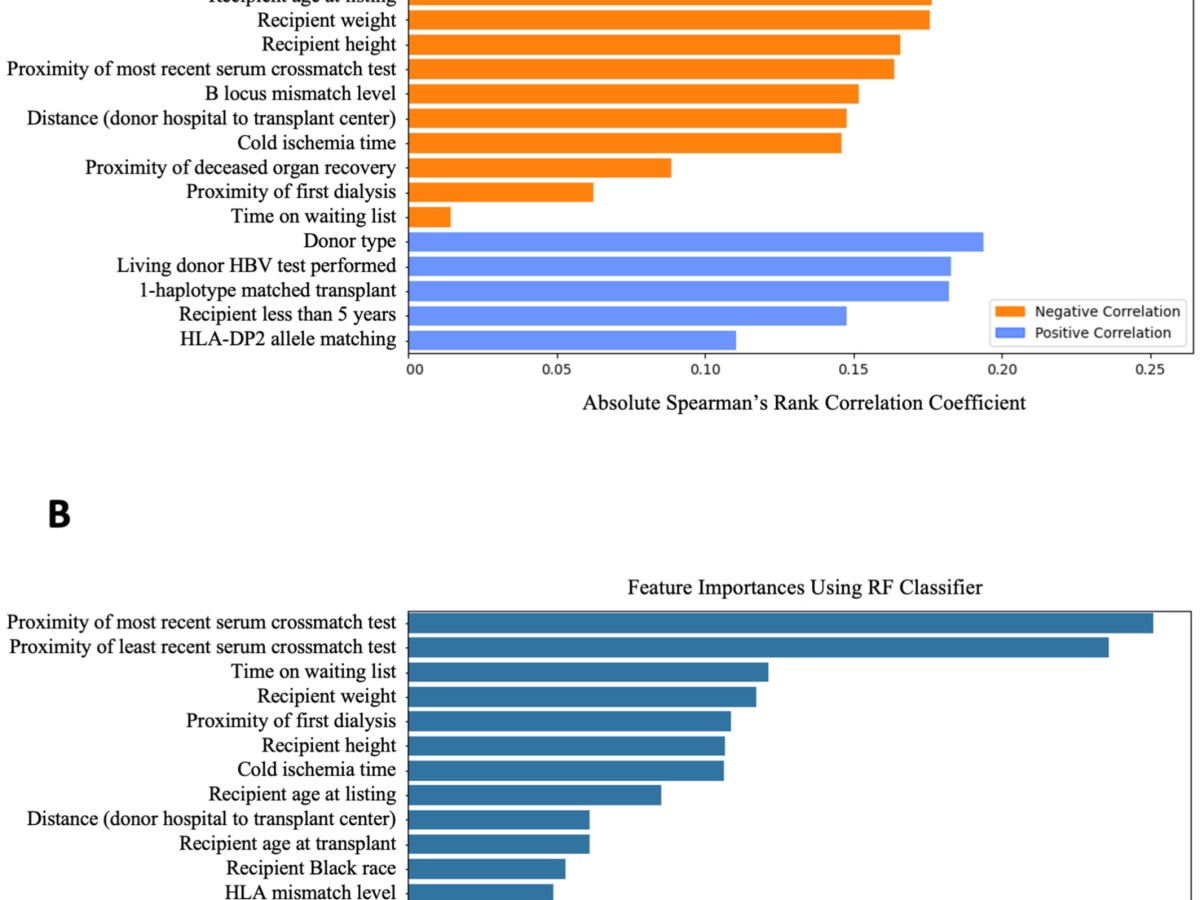
Suh (2025)
Graft failure in kidney transplants Article DOI https://doi.org/10.1111/petr.70043 Objective To identify risk factors for chronic rejection-caused graft failure 15 years post-transplant AI Approach Logistic regression, k-nearest Neighbors, SVM, Decision Tree, ANN, RF Data Source(s) National Standard Transplant Analysis and Research (STAR) dataset (6604 patients) Model Input 19 features, including proximity of most and least recent…
Read More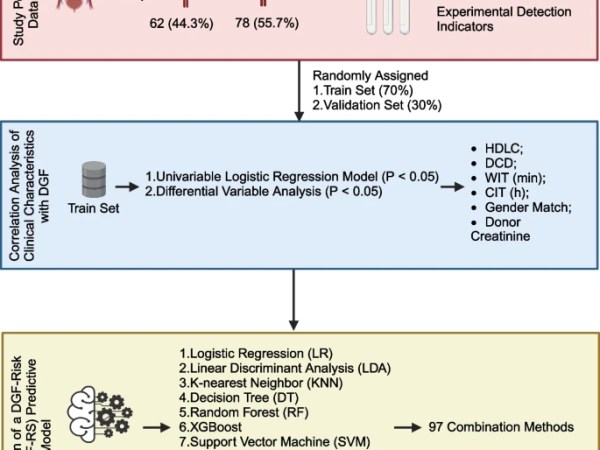
Liu et al. (2024)
Delayed graft function in transplant Article DOI https://doi.org/10.1002/uog.29129 Objective To develop a predictive model for the risk of delayed graft function (DGF) after pediatric kidney transplantation. AI Approach RF, LR, linear discriminant analysis, KNN, DT, XGBoost, SVM, GBM, Naive Bayes, Lasso, Ridge, ElasticNet Data Source(s) Single institutional series (140 patients) Model Input High-density lipoprotein cholesterol,…
Read More
Aksoy et al. (2025)
Graft survival in renal transplantation Article DOI https://doi.org/10.1007/s00467-024-06484-5 Objective To identify factors affecting graft survival in pediatric kidney transplantation AI Approach Naïve Bayes, logistic regression, SVM, multi-layer perception, XGBoost Data Source(s) Single institutional series (465 patients) Model Input 48 variables from patient chart data, including patient demographic characteristics, number of HLA matches, transplant-related variables, and…
Read More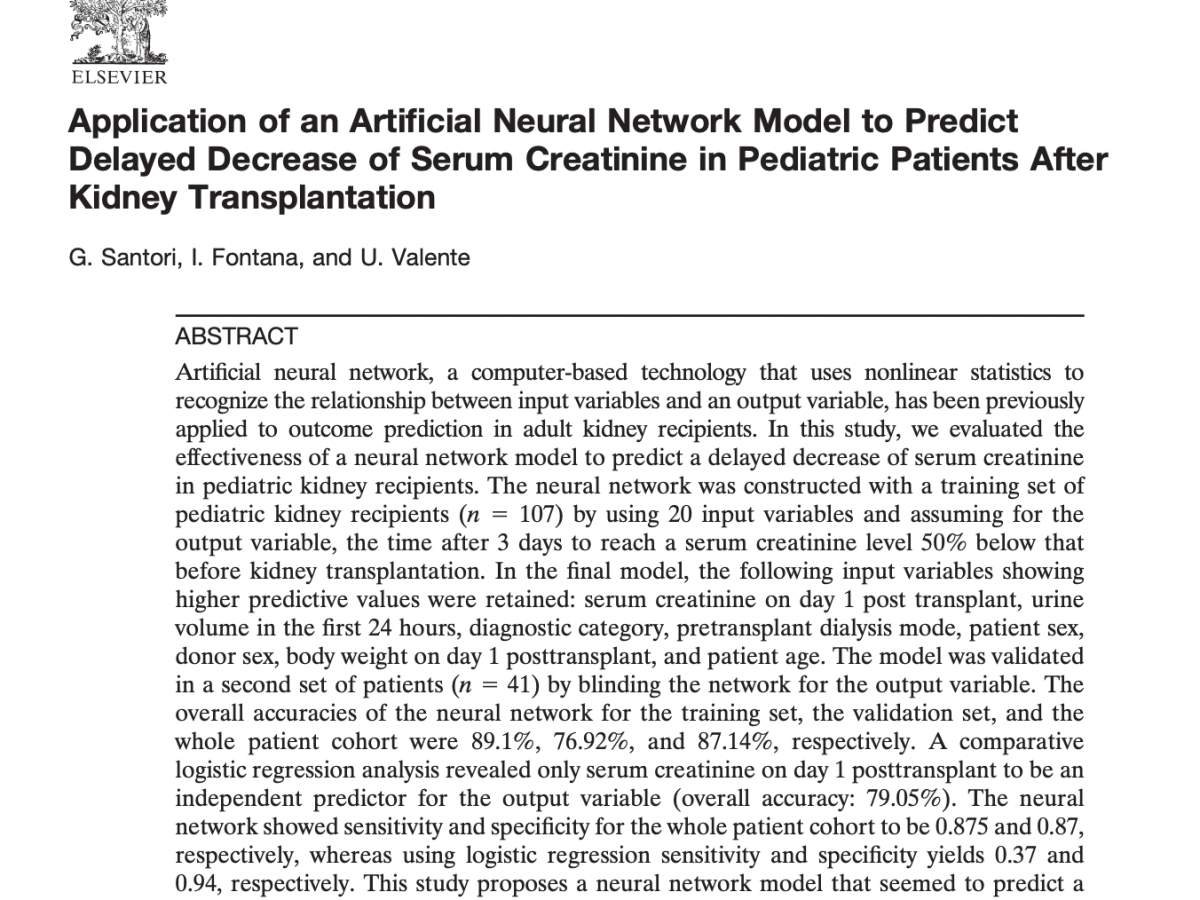
Santori et al. (2007)
Kidney Transplant, Miscelleneous. Article DOI https://doi.org/10.1016/j.transproceed.2007.05.026 Objective To predict delayed decrease in serum creatinine in pediatric kidney recipients AI Approach ANN Data Source(s) Institutional series (148 patients) Model Input 20 variables (incl: patient demographics, early serum creatinine, urine volume, pretransplantcharacteristics) Model Outcome Delayed increase in creatinine Model Metrics AUROC = 0.89, accuracy = 87% Model…
Read More AIPEDURO