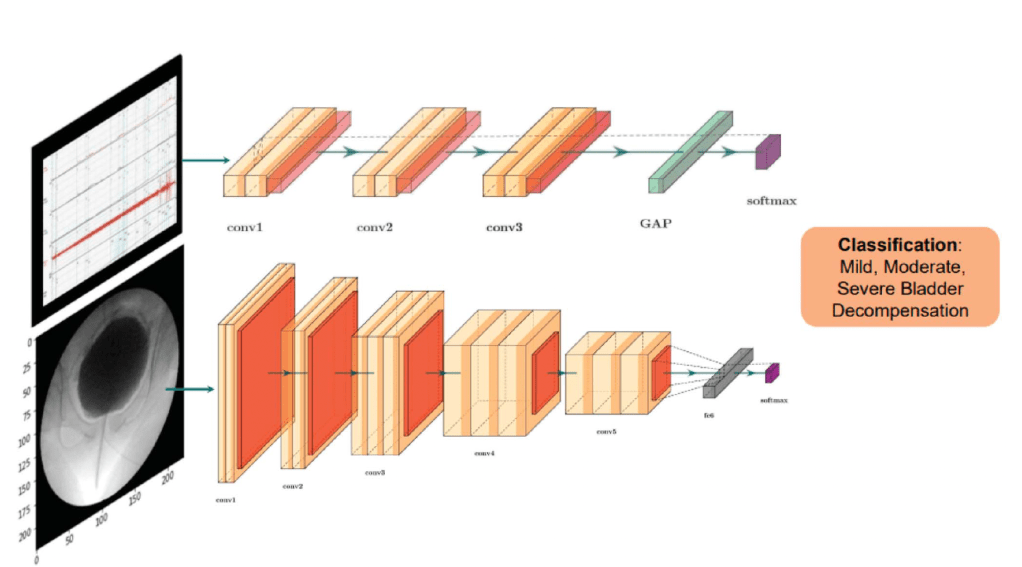
To categorize bladder dysfunction in Spina Bifida, LUTD
| Article DOI | https://doi.org/10.1097/JU.0000000000003267 |
| Objective | To develop deep learning models of VUDS to categorize severity of bladder dysfunction in patients with spina bifida |
| AI Approach | Individual and ensemble model (Random forest, CNN from tracing and imaging, respectively) |
| Data Source(s) | Single institutional series (306 VUDS from 256 patients) |
| Model Input | Clinical: Age, Pressure at 25, 50, 75% EBC; presence of VUR, leak, bladder shape, detrusor sphincter dyssynergia, post-void residual, %EBC achieved Urodynamics: Tracings at 25, 50, 75% EBC; detrusor pressures VUDS: Fluoroscopic images |
| Model Outcome | Mild vs. moderate vs. severe dysfunction |
| Model Metrics | Ensemble model, accuracy of 75% No/mild: AUC of 0.75-0.85; Moderate dysfunction: AUC of 0.64-0.75; Severe dysfunction: AUC of 0.82-0.89 |
| Model Usability | NA |
AI = Artificial intelligence; LUTD = Lower urinary tract dysfunction, CNN = Convolutional neural network, VUDS = Video urodynamics


 AIPEDURO
Leave a comment